How can journalists trust ‘eyewitness video’?
Published on 9th March 2026
BBC Verify's four-step process proves the industry needs a better model
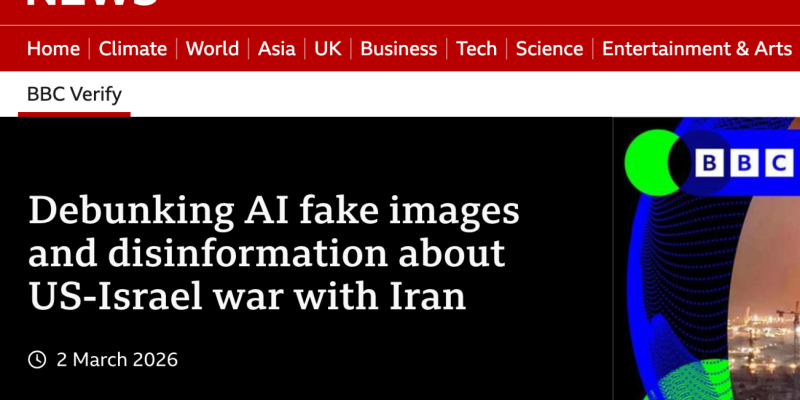
This week, BBC Verify published details of how they authenticate eyewitness footage before it can be shown across the broadcaster’s news channels.
Their team explained how they were able to spot fakes such as:
- an AI-generated explosion falsely attributed to an Iraqi airport
- manipulated satellite images claiming damage to a US Navy base
- bogus social media accounts impersonating senior Iranian clerics
They also showed how they verified legitimate footage such as the US fighter jets shot down over Kuwait, a fire at a Saudi oil refinery, and smoke rising over a French naval base in Abu Dhabi.
BBC Verify runs each individual video through four time-consuming steps to prove its authenticity:
- Look for visual inconsistencies: Check for things that don't look quite right, such as elongated fingers, scrambled text, or other telltale signs of AI generation.
- Look for watermarks: Search for both visible watermarks (like animated logos or symbols in corners) and digital watermarks invisible to the naked eye using tools like SynthID to detect content made with AI tools.
- Find the source: Use reverse image searching to track where the picture or video first appeared online, often tracing back to accounts that openly admit using AI or share similar fakes.
- Speak to the experts: Consult with visual forensics experts and academics daily to confirm findings and carry out independent analysis
Source: BBC Verify
This is what it costs to verify a single clip sourced from social media. Time. Resource. Expertise.
BBC Verify’s team does this work because it has to. Because social media is where eyewitness footage lives now. And social media has no chain of custody.
The question no-one is asking
It all begs the question: why is verification happening at the end of the process instead of the beginning?
The answer is that there hasn't been an alternative. Footage appears on social media. Newsrooms find it. Newsrooms verify it. That's the workflow — and it's been the workflow since smartphones became ubiquitous.
But it doesn't have to be.
Verifying eyewitness footage ‘at source’
Sell-It.Media authenticates footage before it ever reaches a newsroom.
When a submission arrives on the platform, it undergoes moderation before entering a unique auction process.
When a newsroom wins a bid on Sell-It.Media, they receive:
- Footage that has already passed authenticity screening
- A verified source with confirmed identity
- Full legal rights transfer — no copyright uncertainty, no licensing ambiguity
- Raw, high-resolution files — not a screenshot of a social media post
No reverse image searching required. No forensic experts on call. No legal exposure after the fact.
The footage that was already here
The Kuwait fighter jet footage so painstakingly authenticated by BBC Verify today is already on Sell-It.Media. Verified. Auction-ready. Submitted by an eyewitness directly to the platform.
That footage didn't need four steps to authenticate. It only needed one.
Sell-It.Media: The home of eyewitness footage you can trust.
In the last decade, smartphones and social media have made eyewitness footage easier to come by, but harder to verify. The BBC have devoted a whole team to solve this problem, but wouldn’t it be easier if there was a service out there who did the heavy lifting so the media could concentrate on reporting the facts?
“We built Sell-It.Media because we believe speed and verification should not be in opposition. An eyewitness with a phone can deliver footage that is faster, more exclusive, and more trustworthy than anything scraped from social media, as long as the infrastructure exists to support it.” Nick Tapper, Founder, Sell-It.Media
Sell-It.Media is the world's eyewitness footage auction marketplace. Every submission is verified before auction. Verified newsrooms bid for exclusive rights. Sellers get paid the real market rate.